Is this thing worth doing? True-demand value assessment
One of our published methods, written in plain language: what it can do, when to use it, what goes in and what comes out.
Most methods are published as papers or code. This one is written so you can decide whether it fits your problem before you invest time in it.
Read the page top to bottom. If it matches your question, use the online tool - or subscribe and run it on your own data.
A clear answer on what the method does and does not do, plus a live curve from our own demand series. Free to read.
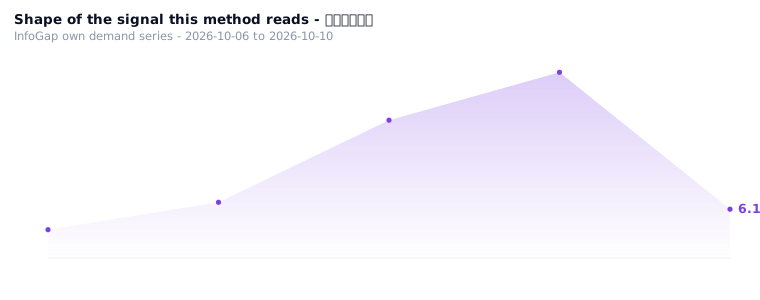
Data base: InfoGap own records - 391 Chinese cities x 8 dimensions, 213,208 city-industry rows, 40,499 POIs (central / lifechain, 2026-10-08).
1In one line: what it does
Score a thing, it tells you what makes it valuable, and it ends with one verdict: "worth doing" or not.
2When to use it
It helps in these three situations:
3What goes in · what comes out
Inputs (this is the exact set used for the real run)
· Product name: Shanghai Chinese medicine clinic
· One-line description: in-store service; from row 15 of the gap table, city demand 0.961, direction up
· Usability, three items (efficiency, cost saving, coverage): 6 / 5 / 5 (out of 10)
· Chance of being displaced by something else: 0.4 (higher = easier to replace)
· How it feels to use, three items (reassurance, pleasure, showing off): 8 / 4 / 3 (out of 10)
· Whether it holds its value (can it be resold, do people recognise it, is it scarce): 2 / 7 / 6
What comes out
These numbers came out of it on the spot, with not one character changed:
Usability value: 0.94 (very high) — held up by "usability"
Feeling value: 0.88 (very strong) — the strongest single item is "reassurance" (against fear)
Holding value: 0.80 (good) — many people recognise it, but hard to resell
All three together: 0.877
Which type it is: 🟢 Function-led (its value comes mainly from usability)
The one-line verdict: ✅ Worth doing (build the chain), reason "overall value 0.877 is not below 0.5"

—— push the scores down (all three usability items set to 1, easy-to-replace set to 0.9) ——
Usability value drops to 0.865, feeling value drops to 0.73
Which shows the score really does follow the numbers you enter.
📈One chart: three kinds of value, which one is not accumulating
Easy to use, good to feel, able to accumulate — the shortest one decides whether the thing can carry a chain.
4How to use it
There is no public calculator for this yet — the method above is the whole procedure, and on this site the inputs have to be keyed in by hand.
- Write down the three groups of scores: usability (efficiency, cost saving, coverage), the chance of being displaced, feeling (reassurance, pleasure, showing off), and holding value (resale, recognition, scarcity)
- Add the product name and the one-line description beside them
- Work out the three sub-scores and the total the same way this page does it in section 3
- Read which of the three is highest, the total score, and that one-line verdict
5Who it is for
People about to open a shop or launch a new product; people who have to pick one project out of several; people who have been told "this one makes money" and want to check it themselves before believing it.
6Common questions
7Related algorithms
✓Why this scenario exists (where the content comes from)
This scenario comes from the records of the "algorithm meets demand" round: the Shanghai · Chinese medicine clinic need was run against three algorithms, and this one was judged "useful" because "the score changes as soon as the inputs change slightly — it is not just decoration".
The inputs and outputs above were obtained by re-running the original inputs in the record: product name "Shanghai Chinese medicine clinic", description from row 15 of the gap table, total score 0.877, verdict "worth doing".
Source: row 15 of the on-site city × industry gap table (Shanghai · Chinese medicine clinic, score=120.10); the D2 record in the matched-need ledger.