Which keywords should you advertise on? Turn guesswork into a ranked keyword list
One of our published methods, written in plain language: what it can do, when to use it, what goes in and what comes out.
Most methods are published as papers or code. This one is written so you can decide whether it fits your problem before you invest time in it.
Read the page top to bottom. If it matches your question, use the online tool - or subscribe and run it on your own data.
A clear answer on what the method does and does not do, plus a live curve from our own demand series. Free to read.
1In one line: what it does
It turns "which words should I be talking to" from guesswork into a keyword list ranked by priority.
2When you would use it
Three situations you are most likely in right now:
3What goes in · what comes out
Input: industry + candidate keywords + the search results each keyword gets on each platform (below is the set from the real run)
- Industry — coffee shop
- Candidate keywords — coffee shop pain points, how to run a coffee shop, coffee shop pitfalls to avoid, coffee shop startup
- coffee shop pain points — Zhihu 1200 results (trust 0.8), Xiaohongshu 3400 (0.7), Baidu 900 (0.6)
- how to run a coffee shop — Zhihu 800 (0.7), Baidu 700 (0.6)
- coffee shop pitfalls to avoid, coffee shop startup — no data supplied
What comes out
Output: the run's own text (not a character changed)
coffee shop pain points   → verified on all 3 platforms, score 0.18, priority P3
how to run a coffee shop  → verified on 2 platforms, score 0.08, priority P3
coffee shop pitfalls      → 0 platforms, score 0.0, priority P3
coffee shop startup       → 0 platforms, score 0.0, priority P3

Elimination list: coffee shop startup
Platform list (8):
  Open, searchable from outside the app: Zhihu, Baidu
  Semi-open: Toutiao, Bilibili, WeChat Search
  Closed, only searchable inside the app: Xiaohongshu, Douyin, Kuaishou
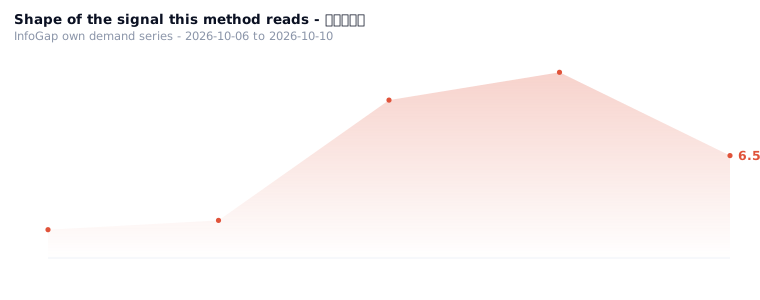
📈One chart: what interest in a candidate keyword looks like day by day
A keyword is not the same from one day to the next; this line is the evidence for "check it daily, do not guess".
4How to use it
There is no public calculator for this yet — the method above is the whole procedure; on this site the inputs have to be keyed in by hand.
- Write down the industry and the candidate keywords
- Record how many results each platform returned for each keyword, and whether you judge that source trustworthy
- Read the ranking and the elimination list, and do the ones people actually search first
5Who it is for
People about to buy ads who need to pick their words first; shop owners whose content nobody reads; people running accounts for somebody else.
6Common questions
7Related algorithms
✓Why this scenario exists (the evidence)
Why this scenario exists:
The most expensive lesson in the overseas scouting report: broad words plus automated bidding, 3 clicks burning 388 dollars, one of those clicks costing 335.80 dollars; another competitor keyword's bill was 8 months, 187 clicks, 4 conversions, 0 customers, at 12.80 dollars a click.
The same report put "search broad match / broad keywords + automated bidding" straight into its top two of things that "look cheap but are actually traps".
Source: the site's overseas ad-scout report dated 2026-09-21.