Is your business a one-off deal or a snowball? Six angles will tell you
One of our published methods, written in plain language: what it can do, when to use it, what goes in and what comes out.
Most methods are published as papers or code. This one is written so you can decide whether it fits your problem before you invest time in it.
Read the page top to bottom. If it matches your question, use the online tool - or subscribe and run it on your own data.
A clear answer on what the method does and does not do, plus a live curve from our own demand series. Free to read.
1In one sentence: what it does
Score six angles once each and see whether your business is a one-off trade, or whether the money it earns goes on to earn more.
2When you use it
Three situations where it helps:
3What you put in · what comes out
Input (this is the exact set used for the real run)
· How often they buy (higher = more often): 4 (out of 5; only "it hurts to stop for a month" counts as really high)
· Is it a must-buy: 2 (out of 5; only "still buys at half again the price" counts as truly essential)
· How much is left on each order: 4 (out of 5)
· Will they keep buying and buying: 3 (out of 5; only "over ninety per cent renew on their own" counts as truly for life)
· Can it run without you: 3 (out of 5; only "it still runs three months after you leave" counts as truly hands-off)
· Can it be handed down: 2 (out of 5)
What comes out
These are the numbers it produced on the spot, not a single character changed:
Compound index (the total it works out; "compound" means the money earned is put back in to earn more): 576 (out of 15625, equivalent to 3.7%)
Average score: 3.0
Did any 0 appear: no (it was not stopped dead)
Grade: 🔴 grade C — the earning is linear, stop and it is gone
The two items most in need of work: is it a must-buy (2 points), can it be handed down (2 points)
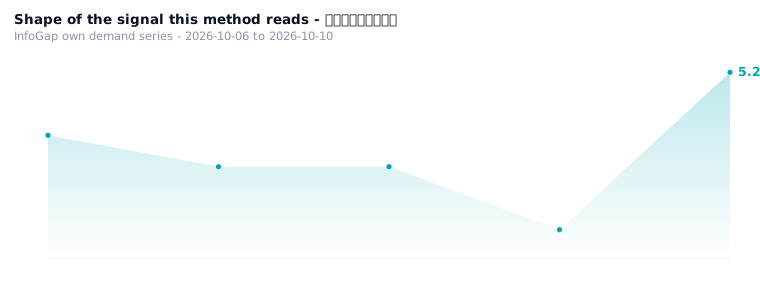
📈One chart: a one-off deal, or a snowball
None of the six angles has caved in — so why is it still grade C? The chart makes it clear.
4How to use it
There is no public calculator for this yet — the method above is the whole procedure; on this site the inputs have to be keyed in by hand.
The input is six scores from 1 to 5. There is no page or form for it here: the rule above is the whole method, and the numbers have to be worked out and keyed in by hand.
- Score each of the six angles yourself (1–5)
- Put the six numbers into the rule above
- First check "did any 0 appear", then look at the grade and the two items most in need of work
- Change the numbers and work it out again to see what moves
5Who it is for
Shop owners who have been going two or three years, taking money but not building savings; people choosing between "earn now" and "roll up slowly"; people who want the business to become something they can hand to someone else to run.
6Common questions
7Related algorithms
✓Why this scenario exists (where the content comes from)
This scenario comes from the records of the "algorithm meets demand" round: the Beijing KTV need was run against several algorithms, and this one was judged useful, on the grounds that "six dimensions at 5 points each → compound index 576/15625, a gate on whether any item is 0, a list of weak spots. Complements the three-dimension fat-profit view (one looks at the track, the other at the model)".
The input and output above are what you get by re-running the set of numbers in that record: 4 / 2 / 4 / 3 / 3 / 2 → index 576, grade C, two weak spots.
Source: row 1 of the site's top-50 gap list (Beijing KTV); the D1 entry in the pairing ledger.