Money, time, skills, health … read it from nine angles and you know which road is yours
One of our published methods, written in plain language: what it can do, when to use it, what goes in and what comes out.
Most methods are published as papers or code. This one is written so you can decide whether it fits your problem before you invest time in it.
Read the page top to bottom. If it matches your question, use the online tool - or subscribe and run it on your own data.
A clear answer on what the method does and does not do, plus a live curve from our own demand series. Free to read.
1In one sentence: what it does
Positions you from nine angles, gives you a one-line profile, and then suggests a few roads you could take right now.
2When you use it
Three situations where it helps:
3What you put in · what comes out
Input (this is the exact set used for the real run)
· Money: 2 (out of 5, "limited budget")
· Time: 3 ("average amount of time")
· Skills: 4 ("solid skills")
· Which stage you are at now: 3 ("growth phase")
· Willingness to take risk: 3 ("neutral")
· Age generation: 4 ("born in the 1980s")
· Physical capacity: 3 ("fair")
· Whether you use tools: 3 ("familiar with tools")
· Where you are: 3 ("a tier-three city")
What comes out
These are the numbers it produced on the spot, not a single character changed:
One-line profile: has skills but lacks money, suited to the road of "turning skills into assets"
Strongest: age generation (born in the 1980s, 4 points)
Weakest: money (limited budget, 2 points)
Tags: limited budget / average amount of time / solid skills / growth phase / neutral / born in the 1980s / fair / familiar with tools / a tier-three city

The three kinds of direction it suggests:
· Skill type: turn your professional knowledge into a course, a tool or a template
· Experience type: use your own experience as content
· Technical type: use ready-made AI tools to produce content in batches

It then goes further and suggests 5 specific roads you can take (with the steps and rough cost of each).
📈One chart: nine angles, and which one has caved in
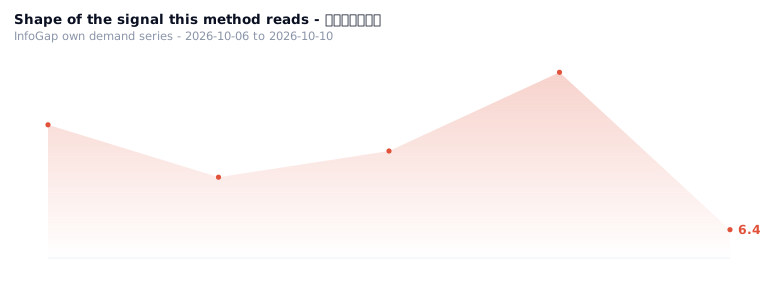
The nine angles draw a shape; where the shape is lopsided is your opening.
4How to use it
There is no public calculator for this yet — the method above is the whole procedure; on this site the inputs have to be keyed in by hand.
The input is nine scores from 1 to 5, plus a number for "how many angles to unlock". There is no page or form for it here: the rule above is the whole method, and the scores have to be worked out and keyed in by hand.
- Score each of the nine angles yourself (1–5)
- Put the nine scores into the rule above
- Read the one-line profile, the weakest item, and the roads it suggests
- Change the scores and work it out again to see what moves
5Who it is for
People who want a side income but do not know where to start; people holding a lot of options who cannot choose between them; people who want to see quickly where someone stands.
6Common questions
7Related algorithms
✓Why this scenario exists (where the content comes from)
This scenario comes from the records of the "algorithm meets demand" round: the promotion-path need from the avatar engine was run against several algorithms, and this one was judged useful, on the grounds that "nine-axis radar + coordinates + profile, usable as the first screen of a free entry point".
The input and output above are what you get by re-running the set of numbers in that record: nine scores 2/3/4/3/3/4/3/3/3 → profile "has skills but lacks money", 5 roads suggested.
Source: the D10 entry in the pairing ledger (the demand came from the promotion path produced by the avatar engine).