Before you start something: are money, time, skills and risk enough?
One of our published methods, written in plain language: what it can do, when to use it, what goes in and what comes out.
Most methods are published as papers or code. This one is written so you can decide whether it fits your problem before you invest time in it.
Read the page top to bottom. If it matches your question, use the online tool - or subscribe and run it on your own data.
A clear answer on what the method does and does not do, plus a live curve from our own demand series. Free to read.
1In one sentence: what it does
Translates "I want to do it" into "can I actually pull it off": whether money, time, skill and risk each come up to the mark.
2When to use it
These three situations call for it:
3What goes in · what comes out
Input (this is the set used for the real run)
· Money: 15 (out of 25)
· Time: 18 (out of 25)
· Skill: 14 (out of 25)
· Can you carry the risk: 12 (out of 25)
What comes out
These numbers are what it produced on the spot, not a character changed:
Landing score (it calls this number the "landing index"): 60 / 100
Grade: 🟡 Grade B — landing feasibility is average; weak spots need fixing

It flagged three items as "needs strengthening":
· Money (15 points) — is there enough funding to start and to keep going?
· Skill (14 points) — do you have the ability required?
· Risk (12 points) — is the risk controllable?

Its action advice:
· Skill falls short — consider adding the skills you need, or finding a partner
· 💡 Once the weak spots are fixed, you can start
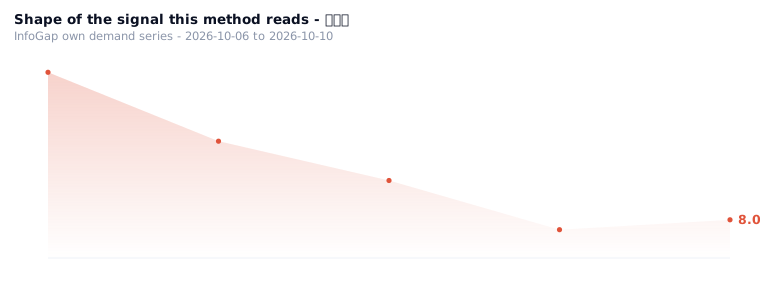
📈One picture: wanting to do it, being able to do it
Money, time, skill and risk — the shortest of the four decides whether you dare to start.
4How to use it
There is no public calculator for this yet — the method above is the whole procedure; on this site the inputs have to be keyed in by hand.
- Score each of the four items (0–25 each)
- Read the weakest item and the action advice it gives
5Who it is for
People with a specific idea in hand who still haven't made a move; people who want to do two things at once; people who have started and find it won't move, and want to know where it is stuck.
6Common questions
7Related algorithms
✓Why this scenario exists (where the content comes from)
This scenario comes from the record of the "algorithms meet demand" round: the Shenzhen · coffee shop demand was run against several algorithms, and this one was judged useful, on the grounds that "funding / time / ability / risk at 25 each → landing index 60, grade B, with a per-dimension 'needs strengthening' output plus follow-up questions. Can go straight onto the landing-assessment page".
The input and output above are what a re-run of that set of numbers gave: 15 / 18 / 14 / 12 → landing index 60, grade B, three items needing strengthening.
Source: row 32 of the site's city × industry opportunity-gap table (Shenzhen coffee shop, score=114.73); the D3 entry in the matching ledger.