Is this demand real, or did you invent it? Six questions to find out
One of our published methods, written in plain language: what it can do, when to use it, what goes in and what comes out.
Most methods are published as papers or code. This one is written so you can decide whether it fits your problem before you invest time in it.
Read the page top to bottom. If it matches your question, use the online tool - or subscribe and run it on your own data.
A clear answer on what the method does and does not do, plus a live curve from our own demand series. Free to read.
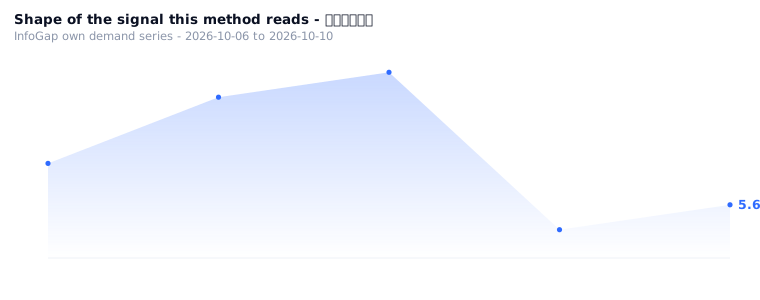
Data base: InfoGap own records - 391 Chinese cities x 8 dimensions, 213,208 city-industry rows, 40,499 POIs (central / lifechain, 2026-10-08).
1In one line: what it does
Spend three minutes answering six questions to judge whether something is "what people actually want", or "what you invented yourself".
2When to use it
These three things are probably happening to you right now:
3What goes in · what comes out
Input: the answers to six questions (this is the exact set used in the real run)
- What he says he wants — a coffee shop where you can get a good shot in one visit
- Has he searched for it — yes
- Has he tried other ways — yes
- Has he paid for this problem — no
- How much would he pay — 60 (out of 100)
- What is he willing to do — willing to leave contact details
What comes out
Output: the text it produced, not a single word changed
Behaviour score 55 / commitment score 19.0 / total 74.0
Verdict: 🟡 potential demand (confidence: medium)
Item-by-item check:
  ✅ Actively searched for a solution (+25)
  ✅ Tried other ways (+30)
  ❌ Has not paid (0)
  ✅ Willing to take a concrete action (+10)
Advice: nudge him into one action, and lower the threshold for the first try
📈One chart: behaviour score against commitment score
For the same demand, being willing to spend time and being willing to spend money are two different things — two bars on the chart.
4How to use it
There is no public calculator for this yet — the method above is the whole procedure; on this site the answers have to be keyed in by hand.
- Write down the six answers for the person you are judging
- Work out the behaviour score and the commitment score from those answers
- Read the total (0–100), the verdict colour, and which items lost points
5Who it's for
People holding an "I think people want this" idea and about to spend money on it; owners who bought traffic but get nobody asking; people helping a friend judge an idea.
6Common questions
7Related algorithms
✓Why this scenario exists (evidence)
Why this scenario exists:
The overseas scouting report has one measured number: forum channels are the cheapest clicks anywhere ($0.13–0.19 each), yet 784 clicks produced only 1 lead. The same report's instruction is — "use it to validate, not as a channel to close deals".
That report holds 21,589 raw samples; 1,374 were sampled out and sent to the model, and 1,120 quotes passed word-by-word verification (any quote the model invented was discarded).
Source: the site's overseas scouting report (the full version is kept as a Markdown file on the overseas research machine).