180 people in round one, only 14 left in round two — can the crowd carry itself?
One of our published methods, written in plain language: what it can do, when to use it, what goes in and what comes out.
Most methods are published as papers or code. This one is written so you can decide whether it fits your problem before you invest time in it.
Read the page top to bottom. If it matches your question, use the online tool - or subscribe and run it on your own data.
A clear answer on what the method does and does not do, plus a live curve from our own demand series. Free to read.
1In one line: what it does
Enter how many came in round one, how many each person brings, and how much each round drops, and see how many are left round by round.
2When to use it
Three situations call for it:
3What goes in · what comes out
Input (this is the exact set used in the real run)
· How many came in round one: 180
· How many each person brings on average: 0.23
· How much each round drops: 0.35 (a drop of about 35%)
What comes out
These numbers are what it produced on the spot, not a single digit changed:
Round 1: 180 people (cumulative 180)
Round 2: 14.35 people (cumulative 194.35)
Round 3: 1.13 people (cumulative 195.48)
Round 4: 0.09 people (cumulative 195.57)
Total people reached: 195
Its verdict: decay is significant — only 0.1% left in the final round

—— with "each person brings 2.5, each round drops only 0.05" ——
Round 2: 22.28 people, round 3: 2.73 people, round 4: 0.33 people
Total people reached: 205
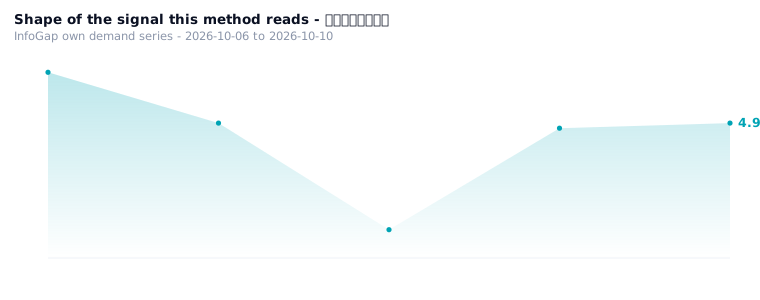
📈One chart: round by round, how many are left
180 people in round one, only 14 left in round two — where exactly does the cliff fall.
4How to use it
There is no public calculator for this yet — the method above is the whole procedure, and on this site the inputs have to be keyed in by hand. The inputs are three numbers: round-one headcount, average invites per person, and how much each round drops.
- Measure three numbers first: how many came in round one, how many each person brings on average, and roughly how much each round drops
- Work the three numbers through the steps above and look at the round-by-round headcount
- Read the per-round headcounts and the "total people reached"
5Who it's for
People who ran an acquisition push and want to review whether it was worth it; people who want to know whether people-to-people spread actually happened; people who want to run the numbers before spending on the next wave.
6Common questions
7Related algorithms
✓Why this scenario exists (where the content comes from)
This scenario comes from the records of the "algorithm meets demand" round: the overseas Chinese community cold-start demand was matched against several algorithms, and this one was judged "useful", on the grounds that it gives "with the same inputs, results consistent with the first few rounds of the water-flow algorithm, and it outputs 'decay is significant, only 0.1% left in the final round'".
The input and output above were produced by re-running the numbers recorded there: 180 people / 0.23 invites each / 0.35 drop per round → per round 180 / 14.35 / 1.13 / 0.09, total 195.
Source: section 5, product 4 of the overseas scouting report; the report's measured wording is "$700 → 77,000 impressions, 180 clicks, 0 signups". The D7 group in the pairing ledger.